
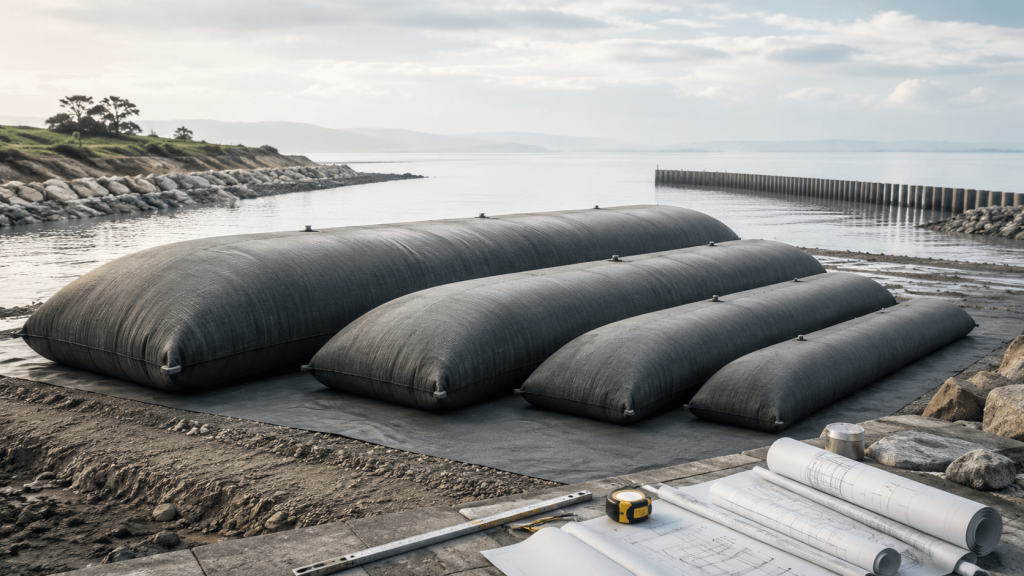
Choosing the right geotube dimensions isn’t just a matter of picking a size off a catalogue — it directly determines how efficiently a project dewaters, how stable the finished structure is, and whether the installation performs as designed over its 20+ year service life.
Whether the application is coastal protection, sludge dewatering, or land reclamation, getting the geotube specification wrong at the planning stage is one of the most common (and most costly) mistakes on a geosynthetic project.
This guide breaks down standard geotube sizing, the technical specifications that matter alongside dimensions, and how to choose the right combination for your project.
A geotube’s size is defined by two primary dimensions:
Together, these determine the tube’s total fill volume and, once filled, its final cross-sectional profile. A wider circumference produces a taller, more voluminous tube once filled; length is generally chosen to match the site’s alignment — a shoreline stretch, an embankment run, or a dewatering pad footprint.
👉 It’s worth noting that circumference is not the same as final diameter. Because the fabric expands and settles as it fills, the achieved diameter is typically less than the flat circumference measurement — a detail that should always be confirmed against the manufacturer’s fill charts rather than assumed.
Dimension | Typical Range |
Length | 22 inches up to 100 feet per tube section |
Circumference | Up to approximately 120 feet |
Filling port spacing | Typically 1 port per 50 feet of length |
Design life | 20 to 50+ years, depending on fill material and site exposure |
Most manufacturers also offer custom sizing beyond these standard ranges, since real project sites rarely match a catalogue dimension exactly. If your project has an irregular alignment, a constrained laydown area, or a specific slurry volume to manage, discussing custom dimensions directly with your installer or manufacturer is usually more efficient than trying to force a standard size to fit.
Dimensions determine how much a tube can hold — but fabric specification determines whether it holds it properly. These are the technical parameters that matter alongside size:
Specification | What It Controls | Typical Range |
Tensile strength | Resistance to pulling stress during filling and hydraulic pressure | Can exceed 200 kN/m for heavy-duty applications |
Apparent Opening Size (AOS / O90) | Largest soil particle size the fabric retains | Roughly 0.2mm–0.6mm depending on slurry type |
Permeability | How quickly water drains through the fabric | Roughly 15–50 L/m²/s, depending on material |
Seam strength | Strength of stitched seams relative to the parent fabric | Should retain at least 80% of parent fabric strength |
UV resistance | Strength retention after prolonged sun exposure | Typically 85–90% strength retained after 500 hours’ exposure |
Fabric weight | Puncture and tear resistance | 540 g/m² and above for heavy-duty coastal applications |
Malaysia’s soft soil conditions, high rainfall, and coastal erosion exposure make correct geotube sizing especially important. A tube undersized for the expected slurry volume means more filling cycles and a longer project timeline; one oversized for the available footprint can create instability on soft ground or uneven settlement on constrained coastal sites.
Getting the size and specification right from the outset — rather than adjusting mid-installation — is what keeps a project on schedule and within budget in these conditions.
A frequent error is selecting geotube dimensions based purely on available stock sizes rather than actual site and slurry requirements — a mismatch that shows up later as slow dewatering, an unstable fill profile, or excessive filling cycles.
Another common issue is overlooking fabric specification entirely, assuming that any geotextile fabric will perform the same regardless of AOS or tensile strength — a costly assumption once fine sediment starts bleeding through an improperly specified fabric, or a heavier fill ruptures a tube specified for lighter-duty use. Finally, underestimating pad preparation is a persistent cause of underperformance: even a correctly sized and specified tube will settle unevenly on a poorly prepared, sloped, or debris-strewn base.
Choosing the correct geotube sizes and geotube specification comes down to working from your actual site conditions and fill material outward — not selecting a size first and hoping it fits. Circumference and length determine capacity; tensile strength, AOS, permeability, and UV resistance determine whether that capacity translates into a stable, long-lasting structure.
For a closer look at how geotubes are installed once sizing and specification are confirmed, our earlier guide on what geotubes are and how they’re installed covers the filling, dewatering, and consolidation process in detail.
If you’re planning a coastal protection, dewatering, or land reclamation project and need help specifying the right geotube dimensions for your site, explore our geosynthetic installation services or get in touch with our team for a project-specific recommendation.
Copyright © Gateway Structure Sdn Bhd (199401025111). All Right Reserved.