
Prefabricated Vertical Drains (PVD) for Land Reclamation Projects in Malaysia
Land reclamation along Malaysia’s coastlines almost always means building on soft, saturated marine clay — ground that can take decades to settle naturally under its own weight.
PVD construction has become the standard ground improvement method for compressing that timeline from decades into months, and it’s the technique behind several of Malaysia’s largest ongoing reclamation projects.
Key Takeaways
- Prefabricated vertical drains (PVDs), also known as wick drains, are polypropylene-core drainage elements wrapped in a geotextile filter jacket, installed to accelerate consolidation of soft clay and silt.
- PVDs work by creating short drainage paths that let water escape sideways and upward when combined with a temporary surcharge load — cutting natural consolidation time from decades to months.
- Installation follows a repeatable grid pattern (square or triangular), with drains driven to the full depth of the soft soil layer using a mandrel rig.
- Malaysia’s major coastal reclamation projects — including Penang South Reclamation, Seri Tanjung Pinang Phase 2, and Forest City in Johor — have all adopted PVDs paired with surcharge loading as their ground treatment approach.
- Quality control depends on verticality, minimal soil disturbance, and material testing for filter density, tensile strength, puncture resistance, and discharge capacity.
- PVDs suit land reclamation, roads, airports, ports, railways, and embankment projects built on soft, compressible ground.
For engineers and developers planning reclamation work on Malaysia’s west coast, where soft marine clay is the norm rather than the exception, PVD construction is often the difference between a buildable site in months and an unusable one for years.
What Are Prefabricated Vertical Drains (PVDs)?
A prefabricated vertical drain, or PVD, is a ground improvement product designed to speed up consolidation in soft clay and silt soils. Each drain consists of a polypropylene core with internal channels that carry water upward, wrapped in a non-woven geotextile filter jacket that keeps soil particles out while letting water pass through.
PVDs are also commonly called wick drains, and they’re used wherever soft, saturated ground needs to be stabilised before construction can proceed — a near-universal condition on Malaysia’s reclaimed coastal sites.
How PVD Construction Works: The Consolidation Process
PVDs don’t drain water on their own — they need a load to push water into them. The process works like this:
- PVDs are installed across the site in a grid pattern, creating short, direct drainage paths through the soft soil
- A surcharge load is applied — typically a temporary soil mound at least as heavy as the planned structure — placed on top of the treated ground
- Pore water pressure rises under the surcharge load, pushing water sideways toward the nearest drain and then upward and out
- Consolidation is monitored using instrumentation until the target settlement is confirmed
- The surcharge is removed, leaving behind ground that has already consolidated to the point the finished structure will require
This process can reduce natural consolidation time from decades to a matter of months — the core reason PVD construction has become standard practice on soft-soil reclamation sites.
PVD Installation Process Step-by-Step
A typical PVD installation sequence follows these steps:
- Inspect drain material for damage upon delivery; repair or discard any compromised sections
- Mark each drain position on site according to the engineer’s design grid (square or triangular spacing)
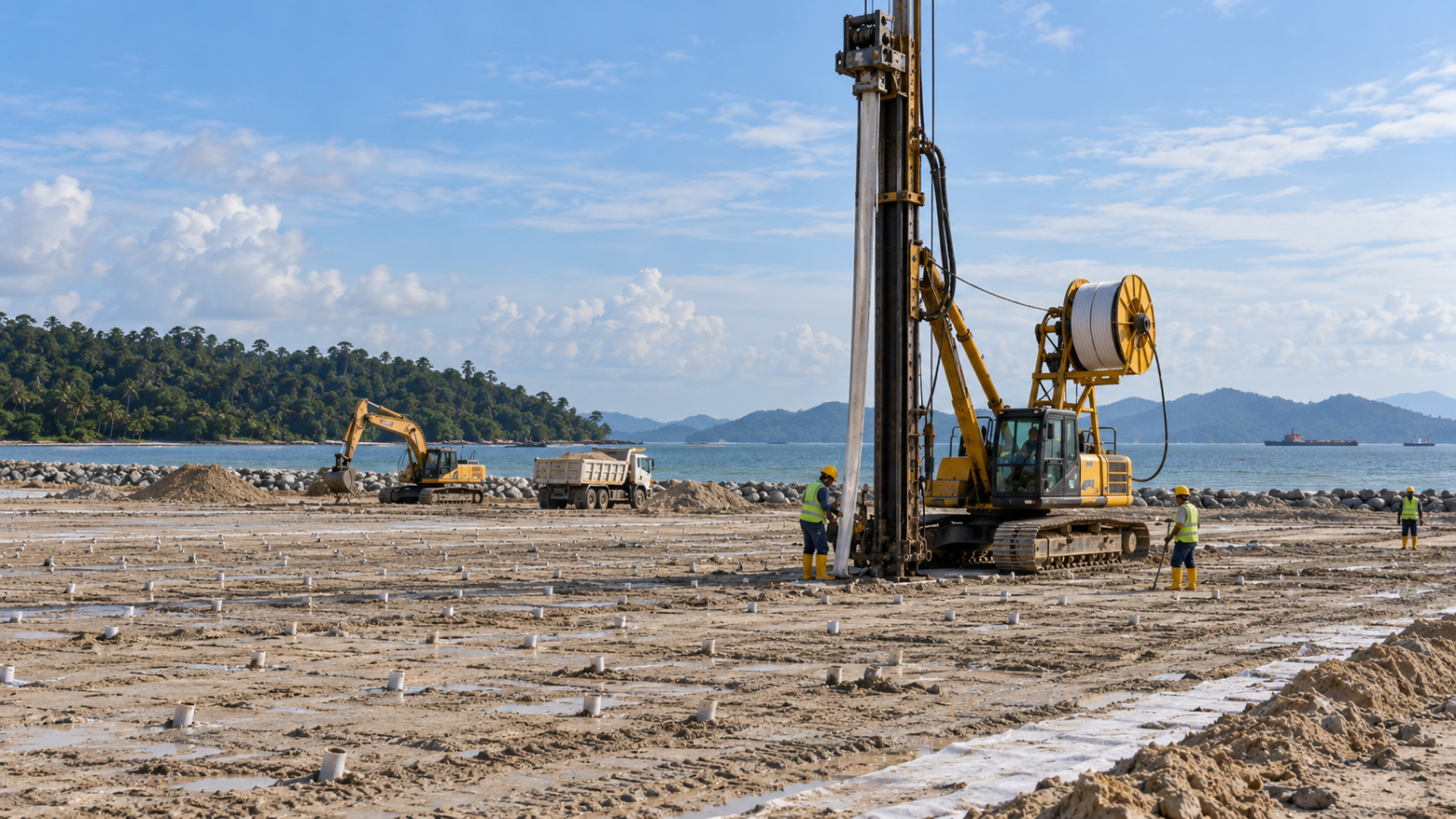
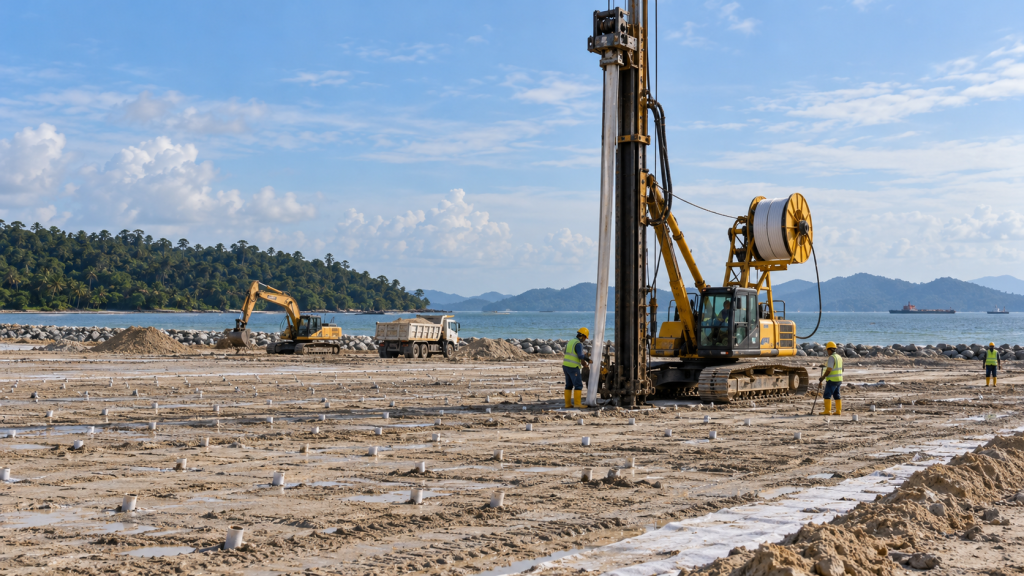
- Mount a roll of PVD material onto an installation rig — typically an excavator or crane fitted with a leader mast — and feed it through a hollow mandrel
- Attach the drain to a disposable anchor plate at the mandrel tip
- Drive the mandrel to the design depth using a vibratory hammer or static force
- Retract the mandrel, leaving the anchor plate embedded in the ground, and cut the drain with a short tail above the surface
- Repeat at every grid point across the treatment area
Drains must reach the full depth of the soft soil layer, ideally terminating in a more permeable layer such as sand, or connecting to a surface drainage blanket to complete the drainage path.
Want to master soft soil consolidation?
Learn more about the PVD installation process in our complete guide.
Why PVDs Matter for Land Reclamation in Malaysia
Malaysia’s west coast reclamation projects sit on some of the region’s most challenging ground conditions, which is exactly why PVD construction has become the default ground treatment approach:
- Penang South Reclamation sits on marine clay up to 23 metres thick. The project’s ground treatment approach pairs PVDs with temporary surcharge loading specifically to dissipate excess pore water pressure and bring long-term settlement within acceptable limits.
- Seri Tanjung Pinang Phase 2 installed PVDs to the full depth of its compressible soil layer, with platform levels set well above the mean high water spring level to control seawater intrusion risk — and the same sand-filling and soil-treatment method used in the project’s first phase is being carried through to the second.
- Forest City in Johor faced a highly compressible silty clay layer roughly 15 to 25 metres thick, treated with sand fill, surcharge loading, and PVDs to accelerate consolidation, backed by ongoing settlement, inclinometer, and piezometer monitoring.
Across all three, the pattern is the same: thick, soft marine clay that would otherwise take years to consolidate naturally, treated with PVDs and surcharge to make the reclaimed land buildable within a realistic project timeline.
Specifications and Quality Control
PVD design and installation quality depend on several factors an engineering team will typically specify and verify:
- Spacing: Set in a square or triangular grid by the project engineer — closer spacing speeds consolidation but increases material and installation cost.
- Depth: Drains must reach the full depth of the soft soil layer, ideally terminating in a permeable layer or connected drainage blanket.
- Material: Polypropylene core with a non-woven polypropylene geotextile filter jacket.
- Installation quality control: Verticality, minimal soil disturbance through correctly sized mandrel and anchor plate, and on-rig monitoring of depth, pressure, and alignment.
- Material testing: Filter density, apparent opening size, burst strength, grab tensile strength, puncture resistance, trapezoidal tear strength, and discharge capacity under both plain and triaxial conditions.
Exact spacing, depth, and cost figures should always be confirmed against project-specific geotechnical design rather than generic benchmarks, since soil conditions vary significantly even within the same reclamation site.
Is PVD the Right Ground Improvement Solution for Your Project?
Is your site underlain by soft, compressible clay or silt?
If so, PVDs combined with surcharge loading are likely to be a relevant ground treatment option worth evaluating against your project’s timeline and loading requirements.
How much time does your project timeline allow for consolidation?
PVD construction is specifically valuable where natural consolidation timelines of years or decades aren’t commercially viable.
Is your project a reclamation, infrastructure, or industrial development on soft ground?
PVDs are widely applied across land reclamation, roads, airports, ports, railways, and embankment construction — anywhere soft ground needs to be stabilised before building can proceed.
Have you confirmed soil conditions through a geotechnical investigation?
Because spacing, depth, and surcharge requirements depend entirely on site-specific soil data, a proper geotechnical assessment should precede any PVD design.
Conclusion: Building on Soft Ground, Faster
Prefabricated vertical drains have become the standard ground improvement method for Malaysia’s coastal reclamation projects precisely because they solve a problem that would otherwise make soft marine clay sites unbuildable within a realistic timeframe. From Penang South Reclamation to Seri Tanjung Pinang and Forest City, the same core approach — PVDs paired with surcharge loading — continues to prove itself on some of the country’s largest land reclamation efforts.
To discuss PVD construction for your reclamation or infrastructure project, contact GSSB’s engineering team, or learn more about our PVD installation services and review related applications in our guide on PVD support for data centre foundations.
Gateway Structure Sdn Bhd (GSSB) is a CIDB G7, ISO-certified geosynthetic specialist contractor serving Malaysia’s infrastructure and reclamation industry since 1994. Beyond PVD installation, our services span geotextiles, geotubes, HDPE geomembranes, geogrids, sand-filled mattresses, and sludge dewatering solutions — supporting projects from coastal protection to large-scale land reclamation across Malaysia.
Frequently Asked Questions about Prefabricated Vertical Drain
Why are prefabricated vertical drains used in land reclamation?
Prefabricated vertical drains are used to accelerate consolidation of soft, saturated soils such as marine clay. They create shorter drainage paths for pore water, allowing reclaimed ground to settle and stabilise faster before permanent structures are built.
How does a prefabricated vertical drain work?
A prefabricated vertical drain consists of a plastic drainage core wrapped in a permeable geotextile filter. When surcharge or preload is applied above the ground, excess pore water is pushed horizontally towards the drains and then discharged vertically towards the surface.
Do prefabricated vertical drains need surcharge loading?
PVDs are commonly used together with surcharge or preloading. The surcharge increases pore water pressure in the soft soil, while the vertical drains provide a shorter route for the water to escape. This combination accelerates consolidation compared with relying on natural drainage alone.
How long does soil consolidation take with PVDs?
There is no fixed consolidation period. It depends on soil thickness, permeability, PVD spacing, surcharge height and the required degree of consolidation. Malaysian projects and studies have reported consolidation periods of several months, but the actual programme must be determined from project-specific geotechnical data and field monitoring.
What types of soil are suitable for prefabricated vertical drains?
PVDs are mainly used in soft, compressible and low-permeability soils such as marine clay, silty clay and soft alluvial deposits. They are particularly useful where natural consolidation would otherwise take years.
How deep are prefabricated vertical drains installed?
PVD depth depends on the thickness of the compressible soil layer. The drains are generally designed to penetrate through the soft layer to the required treatment depth identified by the geotechnical investigation. Reclamation and infrastructure projects in Malaysia may involve soft clay extending more than 20 metres below ground level.
How is PVD spacing determined?
PVDs are commonly arranged in square or triangular patterns. The spacing is determined by the required consolidation period, soil properties, drainage conditions and project programme. Closer spacing can accelerate consolidation but also increases the quantity of drains required.
Can prefabricated vertical drains prevent future settlement completely?
PVDs are designed to accelerate primary consolidation before permanent construction begins, reducing the amount of settlement that occurs later. They do not eliminate every form of future settlement, so residual and secondary settlement must still be considered in the geotechnical design.