
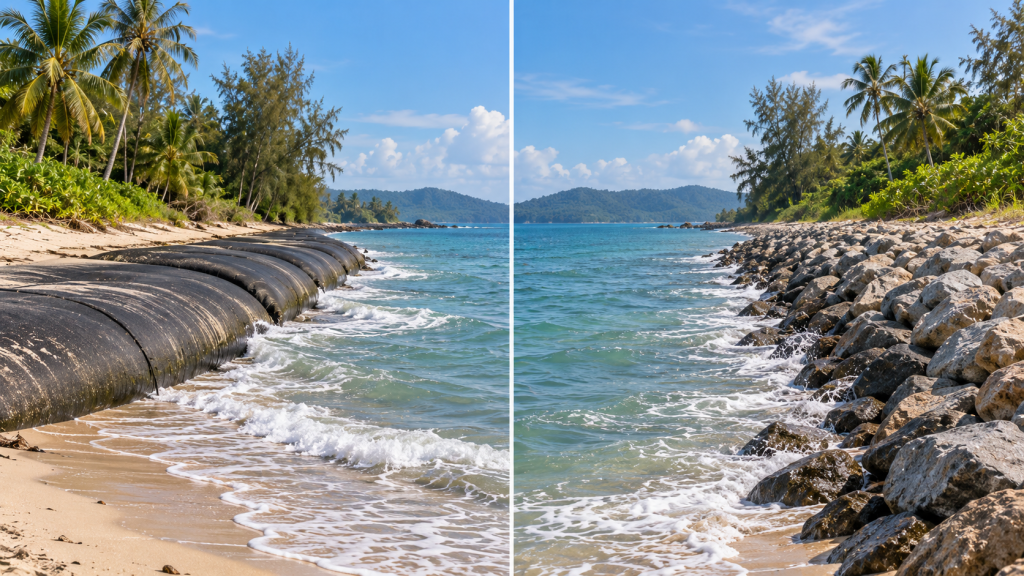
Choosing the right method to protect a shoreline, riverbank, or reclamation edge is a decision that shapes a project’s cost, timeline, and long-term maintenance obligations. Two of the most widely used approaches — geotube systems and traditional rock revetment — solve the same problem through very different mechanisms.
Understanding how each performs under real site conditions is essential before committing to either for a shoreline protection or erosion control project.
For civil engineering and civil construction teams evaluating erosion control options, the decision usually comes down to matching the method’s strengths to the specific demands of the site.
A geotube (geotextile tube) is a large tubular container manufactured from high-strength, permeable geotextile fabric. It is filled with sand, dredged sediment, or slurry, while the fabric allows water to drain through — a process GSSB describes as filling, dewatering, and consolidation. As water drains out, the contained material densifies and the tube settles into a stable, compact form.
Geotubes are used across several applications:
Fabric performance depends on tensile strength, seam strength, permeability, Apparent Opening Size, and UV resistance — specifications that vary by project and are detailed further in GSSB’s geotube sizing and specification guide.
Rock revetment is a sloped structure built from graded stone or armour rock, placed along a shoreline or embankment to absorb and dissipate wave energy before it reaches the soil behind it. Unlike a geotube, which relies on a filled fabric shell, rock revetment relies entirely on the mass and interlocking arrangement of individual stones.
Because the material itself is inert rock, it doesn’t degrade through UV exposure, corrosion, or fabric wear — the same mechanisms that can affect geotextile-based systems over very long timeframes. Revetments are a long-established method in coastal and riverbank engineering, particularly where high wave energy and long design life are the primary concerns.
A geotube is a large, high-strength permeable fabric tube filled with sand, slurry, or dredged marine sediment, forming a flexible, consolidated mass once dewatered. Rock revetment, by contrast, is a sloped, permeable structure built from natural stone, heavy rip-rap, or concrete armour units, relying on mass and interlocking placement rather than a fabric shell.
The two methods dissipate wave energy through entirely different mechanisms. A geotube’s deformable fabric surface absorbs and cushions impact energy, reducing wave reflection as the structure flexes under load. Rock revetment instead relies on the irregular voids between individual stones, which create turbulence that breaks up and dissipates heavy wave forces before they reach the slope behind.
Geotubes are generally faster to deploy and more cost-effective, since local sand or dredged material can be pumped directly into the tube on site, reducing the need for material transport. Rock revetment is typically more expensive and time-intensive, since it requires heavy machinery and transport to haul large armour stones to the site before placement can begin.
Geotubes are manufactured with UV-stabilised materials and remain flexible on soft soil foundations such as mud or silt, though the fabric is vulnerable to punctures or sharp debris. They can also be covered with sand or vegetation to blend into the surrounding landscape.
Rock revetment is extremely durable and long-lasting in high-energy storm environments, but its solid structure reduces land-to-water ecological connectivity along the shoreline.
Geotube systems are best suited to low-to-moderate wave energy environments, soft soils, projects needing rapid temporary or semi-permanent protection, and sites where beach nourishment integration is a goal.
Rock revetment is best suited to moderate-to-high wave energy zones, permanent shoreline stabilisation, and heavily storm-exposed coasts where long-term structural permanence outweighs flexibility.
Geotube | Rock Revetment | |
|---|---|---|
Material | High-strength permeable geotextile fabric | Natural stone, rip-rap, or concrete armour units |
Energy dissipation | Flexible fabric absorbs and cushions wave impact | Stone voids create turbulence to break up wave force |
Cost & speed | Faster, more cost-effective with local fill material | Slower and costlier due to stone transport and heavy machinery |
Durability | UV-stabilised, flexible on soft soils, vulnerable to punctures | Extremely durable in high-energy storms, but reduces ecological connectivity |
Best suited for | Low-to-moderate wave energy, soft soils, rapid/semi-permanent protection | Moderate-to-high wave energy, permanent stabilisation, storm-exposed coasts |
Geotube installation generally follows this sequence:
Rock revetment installation, by comparison, typically involves slope preparation and grading, placement of a filter layer (often a geotextile) to prevent soil migration, and systematic placement of graded stone from the toe of the slope upward — a process that generally demands more site access for heavy equipment and a longer overall placement timeline.
How energetic is the wave or flow environment?
High-energy coastal zones with sustained wave action have historically favoured rock revetment’s proven long-term performance. Moderate-energy sites, reclamation edges, and riverbank protection often suit geotube systems well.
How much shoreline space is available?
Where space is constrained, a geotube’s smaller footprint and ability to conform to irregular terrain can be a decisive advantage over a wider stone slope.
What’s the project timeline?
Geotube systems can generally be deployed faster, particularly where fill material is locally available and heavy stone transport would otherwise cause delays.
What’s the expected design life, and is reversibility important?
Rock revetment’s permanence suits long-design-life infrastructure. Where future modification or removal may be needed, a geotube system offers more flexibility.
Could a hybrid approach work better?
Many projects don’t need to choose exclusively — geotubes integrated with stone armour or geobags, such as in GSSB’s sand-filled mattress erosion protection case study, can combine the speed of geotextile systems with the added surface durability of traditional protection methods.
The single most expensive mistake in data centre development is treating ground conditions as a problem to solve after site selection, rather than a factor in choosing the site itself. A location with excellent power and fibre connectivity is still a poor choice if its soil conditions require months of unplanned ground improvement work that wasn’t budgeted or scheduled into the original project timeline.
Bringing geotechnical assessment into the site selection process — not just the construction planning phase — gives developers a realistic view of both cost and timeline before commitments are made.
Neither geotube systems nor rock revetment is universally superior — each solves coastal and shoreline erosion differently, and the right choice depends on wave energy, available space, project timeline, and long-term design requirements. For teams evaluating these options for an upcoming civil engineering project, a site-specific assessment is the only reliable way to determine which method delivers the right balance of performance, cost, and maintenance over the structure’s design life.
To discuss which erosion control solution fits your project’s specific site conditions, contact GSSB’s engineering team, or review examples of past installations in our project portfolio.
Copyright © Gateway Structure Sdn Bhd (199401025111). All Right Reserved.