
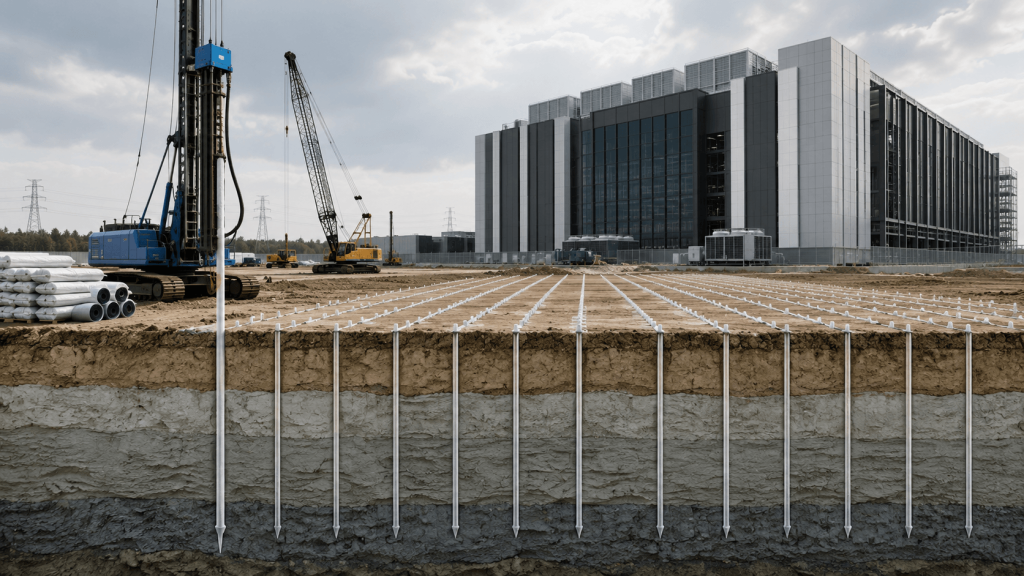
Malaysia’s data centre pipeline is expanding fast — across Johor, Cyberjaya, and the Klang Valley — and much of that expansion sits on soft marine clay, reclaimed land, or peat. That’s a serious problem for a building type with almost zero tolerance for settlement.
A data centre’s raised floors, precision cooling systems, and heavy switchgear can’t shift even slightly without risking equipment misalignment or costly downtime.
This guide breaks down what developers need to know about ground conditions, foundation loads, and how Prefabricated Vertical Drains (PVDs) fit into building a stable data center foundation Malaysia developers can actually rely on.
Data centres are not ordinary buildings. Warehouse-scale floor loads, dense server racks, generator enclosures, chillers, and switchgear routinely require foundations designed for column loads exceeding 4,000 kN and slab loads of 50 kPa or more.
Weak, untreated soil under those loads doesn’t just risk settlement — it risks differential settlement, where one part of the slab sinks more than another. For a conventional warehouse, that might mean a cracked floor. For a data centre, it can mean misaligned raised flooring, damaged precision equipment, and operational disruption that’s far more expensive than the fix would have been at the foundation stage.
This is why ground improvement — strengthening the soil itself before construction — has become such a central part of data center infrastructure planning across the region, rather than an afterthought handled after the building design is finalised.
Several of Malaysia’s most active data centre corridors sit on soil conditions that require careful geotechnical planning:
The common thread across these data center locations is that soil suitability is rarely uniform even within a single site — which is exactly why proper soil investigation needs to happen before a location is finalised, not after.
Prefabricated Vertical Drains — also known as wick drains — are a ground improvement technique used to accelerate consolidation in soft, saturated clay and silt. When heavy loads are placed on this kind of soil, the pressure is initially carried by trapped water in the soil’s pores. Because these soils have very low permeability, that water can’t escape quickly on its own — a process that, left alone, can take decades to fully settle.
PVDs shorten that timeline dramatically. Installed vertically into the ground in a grid pattern, they create short, direct drainage paths that let trapped water escape both radially and vertically — rather than having to travel the full depth of the soil layer to find an exit. Combined with surcharging (a temporary preload placed on the site, equal to or greater than the final structure’s load), PVDs can compress a consolidation timeline that would otherwise take decades down to a matter of months.
For a closer technical breakdown of how PVDs are engineered and installed, our guide on Prefabricated Vertical Drains (PVD) installation covers the anatomy, installation process, and quality control measures in detail.
Data centre developers often ask how PVDs compare to other ground improvement approaches, such as Controlled Modulus Columns (CMC) or Deep Soil Mixing (DSM). Each has a different fit:
|
Method |
Best Suited For |
Key Trade-off |
|
PVD + Surcharge |
Large, flat-footprint sites with schedule room for a preload-and-monitor phase |
Requires lead time for consolidation to complete before construction |
|
Controlled Modulus Columns (CMC) |
Sites needing faster foundation readiness without deep excavation |
Higher cost per unit area than PVD; well suited to compressed schedules |
|
Deep Soil Mixing (DSM) |
Coastal or reclaimed sites with high moisture content or organic soils |
Requires binding agents (cement/lime) mixed into the soil; more equipment-intensive |
For data centre projects where the site footprint is large and there’s flexibility in the construction timeline, PVD with surcharge preloading is often the most cost-effective route to a stable, settlement-resistant foundation — particularly compared to deep foundation systems like driven or bored piles, which carry significantly higher material and labour costs.
Where schedules are extremely tight and no preload window exists, rigid inclusion methods like CMC may be a more practical fit, sometimes even in combination with PVD across different zones of the same site.
Building on soft ground follows a fairly consistent sequence, regardless of which ground improvement method is ultimately used:
Skipping or compressing any of these steps — particularly the monitoring phase — is one of the most common causes of later settlement problems on data centre projects, since consolidation that looks “close enough” on paper can still leave residual settlement risk if it isn’t properly verified.
Two factors drive the effectiveness of any PVD system: spacing and depth. Closer drain spacing shortens consolidation time but increases material and installation cost, so the design needs to balance project timeline against budget.
Depth is determined by the thickness of the compressible soil layer — drains need to penetrate the full depth of the soft material, ideally terminating in a more permeable layer or connecting to a surface drainage blanket so collected water has somewhere to go.
Quality control matters just as much as design. Verticality of each drain, minimal soil disturbance during installation, and proper monitoring of installation depth and pressure are all critical — deviations here can quietly reduce a well-designed system’s effectiveness without being visible until settlement issues appear later.
The single most expensive mistake in data centre development is treating ground conditions as a problem to solve after site selection, rather than a factor in choosing the site itself. A location with excellent power and fibre connectivity is still a poor choice if its soil conditions require months of unplanned ground improvement work that wasn’t budgeted or scheduled into the original project timeline.
Bringing geotechnical assessment into the site selection process — not just the construction planning phase — gives developers a realistic view of both cost and timeline before commitments are made.
Data centres require foundations that can support extreme column and slab loads without differential settlement, since even minor uneven settling can misalign raised floors and damage sensitive equipment.
Prefabricated Vertical Drains accelerate the consolidation of soft, saturated soil by creating short drainage paths that let trapped pore water escape quickly, shortening a process that could otherwise take decades to a matter of months when combined with surcharge preloading.
PVDs work particularly well on large, flat-footprint sites with schedule flexibility for a preload phase. Sites with extremely tight timelines or highly variable soil conditions may benefit from combining PVD with other methods like Controlled Modulus Columns.
Timeline depends on soil depth, spacing design, and surcharge duration, but a well-designed PVD and surcharge programme can reduce consolidation from decades to a period of months.
Before. Geotechnical assessment should be part of the site selection process itself, since a location’s soil conditions directly affect both foundation cost and construction timeline.
As Malaysia’s data centre pipeline continues to grow across Johor, Cyberjaya, and beyond, the developers who plan for soil conditions early — rather than reacting to them after site selection — are the ones who keep projects on schedule and on budget. PVD systems remain one of the most cost-effective ways to turn soft, compressible ground into a stable foundation for high-load, settlement-sensitive infrastructure like data centres.
If you’re planning a data centre development on soft or reclaimed ground, explore our PVD installation services or get in touch with our team for a site-specific ground improvement assessment.
Copyright © Gateway Structure Sdn Bhd (199401025111). All Right Reserved.