
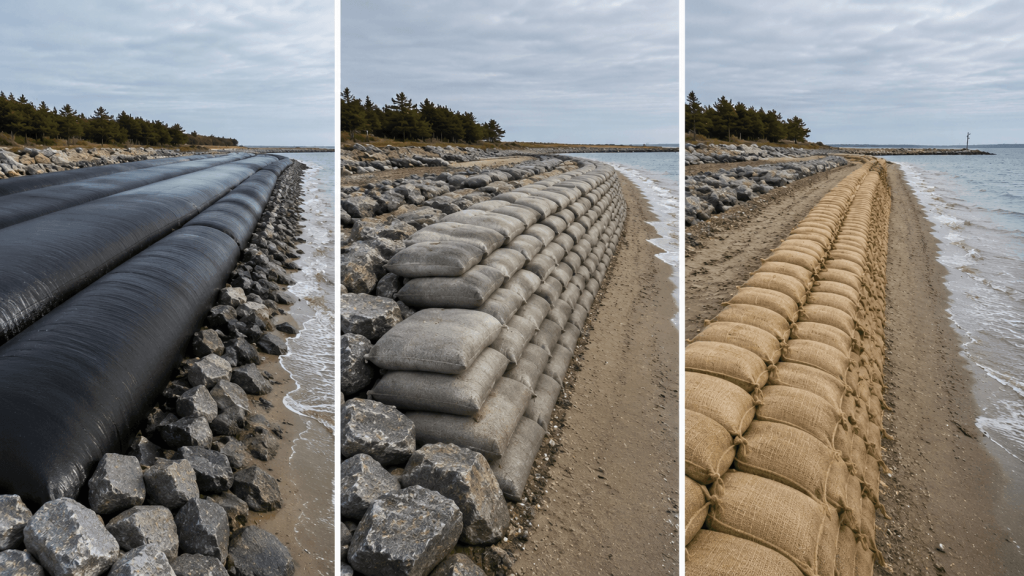
Malaysia’s coastline faces persistent erosion pressure from monsoon wave action, tidal surge, and rising development along the shore. When it comes to protecting that coastline — or managing dredged material, riverbank erosion, or emergency flood response — three geotextile-based solutions dominate the conversation: geotubes, geobags, and traditional sandbags.
They’re often used interchangeably in casual conversation, but they’re built for genuinely different jobs. Choosing the wrong one doesn’t just waste budget — it can mean a structure that fails well before its intended service life.
This guide breaks down the real differences to help you make the right call for your coastal erosion control project in Malaysia.
Feature | Geotube | Geobag | Traditional Sandbag |
Typical size | Up to 100 ft length, up to ~120 ft circumference | 2–10 m³ per unit | Small, individually handled |
Filling method | Hydraulic pumping of slurry (sand/water mix) | Mechanically filled, closed by sewing or rope joints | Manually filled with sand |
Placement | Positioned and filled in place | Filled, then lifted and positioned as a unit | Manually stacked |
Dewatering function | Yes — engineered filtration and consolidation | Limited | None |
Typical applications | Breakwaters, large revetments, land reclamation, sludge dewatering | Scour protection, riverbank stabilisation, modular revetments, temporary cofferdams | Emergency flood barriers, short-term erosion response |
Design life | 20–50+ years | Several years to over a decade, depending on fabric grade | Weeks to months |
Scale of project | Large, linear coastal or dewatering structures | Medium-scale, modular structures | Small, temporary, emergency use |
A geotube (or geotextile tube) is a large tubular container made from high-tenacity woven geotextile, filled hydraulically by pumping a sand-and-water slurry through fill ports along its length. As water drains through the engineered fabric pores, solids remain inside and gradually consolidate into a stable, load-bearing structure.
Geotubes are typically sized from around 22 inches up to 100 feet in length, with circumferences reaching approximately 120 feet, though manufacturers can produce custom dimensions to match project-specific needs.
👉 Geotubes are the go-to solution when a project needs both containment and dewatering in a single system — think large-scale breakwaters, groynes, revetments, or sludge and dredged-material management.
A geobag is a smaller, sewn geotextile container — typically holding between 2 and 10 m³ — filled mechanically with sand or aggregate rather than pumped as a slurry. Once filled and closed (via sewing or rope joints), geobags are lifted and positioned individually, making them a modular building block rather than a single continuous structure like a geotube.
Geobags are hydraulically stable, UV resistant, and designed to absorb wave energy directly, which makes them well suited to scour protection, riverbank stabilisation, groyne construction, and revetments built up from multiple individually-placed units.
Traditional sandbags are the simplest and smallest of the three — woven polypropylene or jute bags filled manually with sand, typically deployed for emergency, short-term flood barriers or temporary erosion response. They lack the engineered filtration properties of geotextile fabric, meaning they don’t dewater or filter effectively, and standard sandbag material degrades quickly under prolonged UV and moisture exposure.
For genuinely temporary applications — an unexpected flood event, a short-term construction barrier — sandbags remain a practical, low-cost option. But they were never designed to hold up as a long-term coastal structure.
Geotubes form long, continuous structures ideal for linear coastal defences like breakwaters and shoreline revetments. Geobags are modular — placed individually or stacked to build up a structure — which gives more flexibility for irregular shorelines, riverbanks, or sites where a continuous tube isn’t practical.
Geotubes are hydraulically pumped with a slurry mix, which is what enables their dewatering function. Geobags are mechanically filled with sand or aggregate and then closed, without the same dewatering mechanism — they’re built primarily for containment and mass, not filtration.
This is the defining difference. If a project needs to separate solids from water — sludge dewatering, dredged material management, land reclamation fill consolidation — a geotube is purpose-built for that. Geobags aren’t designed around dewatering in the same way, though their permeable fabric does allow some water passage during placement.
Geotubes are generally the choice for large-scale, high-volume projects where a continuous structure and dewatering are both required. Geobags suit medium-scale, modular applications where flexibility in placement matters more than a single continuous run.
Malaysia’s coastline experiences sustained monsoon wave action, high UV exposure, and persistent tidal cycles — conditions that break down standard sandbag material far faster than engineered geotextile fabric. A traditional sandbag structure exposed to this environment can visibly degrade within weeks to months, long before it delivers meaningful protection against seasonal erosion.
For any coastal protection project expected to perform beyond a single storm season, a geotube or geobag system — built from UV-resistant, high-tenacity geotextile — is the only realistic option for genuine long-term durability.
Ask these questions before choosing your coastal protection method:
Geotubes, geobags, and traditional sandbags each solve a genuinely different problem — scale, dewatering need, and required service life should drive the decision, not upfront cost alone.
For most permanent or long-term coastal erosion control projects in Malaysia, geotubes and geobags are the only realistic options; sandbags remain useful, but only for short-term emergency response.
For a deeper technical look at geotube sizing and how these systems are installed, our earlier guides on what geotubes are and how they’re installed cover the process in detail.
If you’re planning a coastal protection, riverbank stabilisation, or dewatering project and need help choosing between geotube and geobag systems, explore our geosynthetic installation services or get in touch with our team for a project-specific recommendation.
Copyright © Gateway Structure Sdn Bhd (199401025111). All Right Reserved.