
Key Takeaways
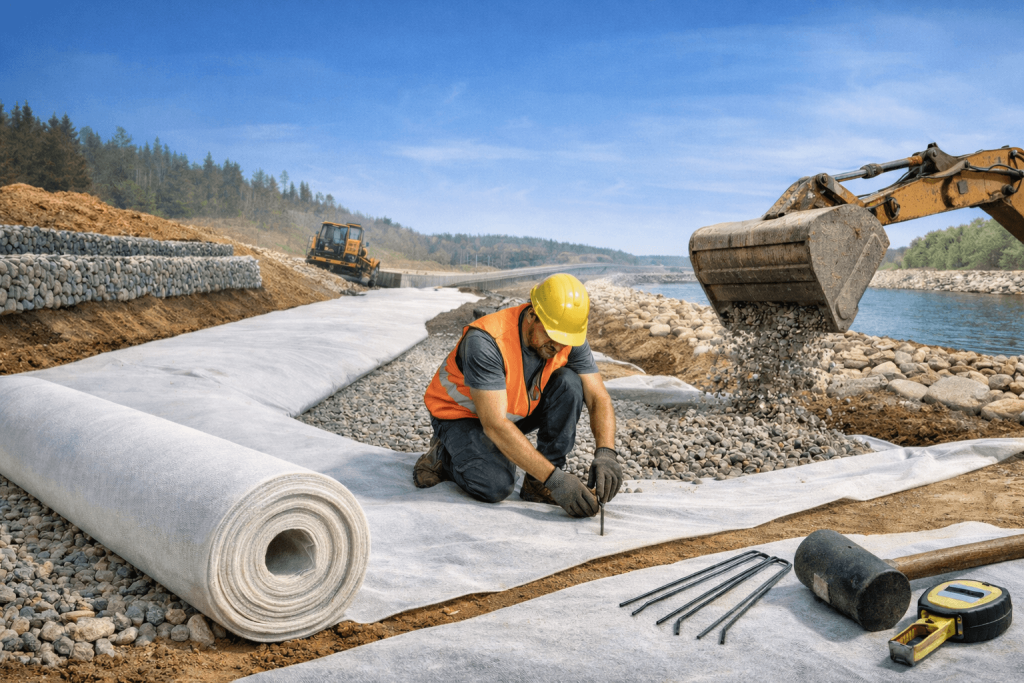
Geotextile installation involves preparing the ground, laying geotextile fabric, joining adjacent sections, securing the material and placing protective fill.
Woven and non-woven geotextiles serve different engineering functions, including separation, filtration, drainage and reinforcement.
Installation requirements depend on soil conditions, material specifications and approved engineering drawings.
Geotextile overlap widths and anchoring arrangements should follow project requirements rather than universal measurements.
Proper quality control helps identify fabric damage, incorrect placement and jointing defects before the material is covered.
Geotextile fabric is widely used in Malaysian civil engineering projects, including road construction, embankments, drainage systems, retaining structures and erosion control works.
However, selecting the correct material is only part of ensuring that the geotextile performs its intended function. Improper installation may cause fabric damage, displacement, inadequate filtration or reduced reinforcement performance.
Geotextile installation requires careful site preparation, accurate fabric placement, appropriate joining methods and controlled backfilling.
This guide explains how to install geotextile fabric, common installation mistakes and the considerations contractors and engineers should review for Malaysian construction projects.
Geotextile installation is the process of placing, joining, securing and covering engineered geotextile fabric within a soil or civil engineering structure.
Geotextiles are permeable synthetic fabrics commonly manufactured using polymers such as polypropylene or polyester.
Depending on the material and engineering design, they may provide separation, filtration, drainage, reinforcement or protection.
A typical geotextile installation involves eight stages:
Site assessment and planning
Ground preparation
Measuring and cutting
Fabric placement
Securing the fabric
Overlapping or seaming
Backfilling and covering
Inspection and quality control
The appropriate procedure varies according to the geotextile’s engineering function, site conditions and approved project specifications.
For a broader introduction, read GSSB’s guide on geotextile types, functions and applications.
Selecting a suitable geotextile is important because different materials provide different engineering characteristics.
Woven geotextiles are manufactured by interlacing polymer yarns or tapes.
Depending on their specification, woven geotextiles may provide relatively high tensile strength and controlled deformation characteristics.
They are frequently considered for applications involving:
Road subgrade separation
Embankment construction
Soil reinforcement
Ground stabilisation
The geotextile’s tensile properties, permeability and installation orientation should match the approved design.
Non-woven geotextiles are commonly manufactured through needle-punching or thermal bonding processes.
They are frequently selected for filtration, drainage, separation and protection applications.
Typical applications include drainage systems, erosion control and geosynthetic protection layers.
| Feature | Woven Geotextile | Non-Woven Geotextile |
|---|---|---|
| Manufacturing | Interlaced yarns or tapes | Bonded or mechanically entangled fibres |
| Common functions | Separation and reinforcement | Filtration, drainage, separation and protection |
| Tensile characteristics | Often selected for higher tensile requirements | Vary according to product specification |
| Filtration properties | Product-dependent | Often selected for filtration applications |
| Installation | Based on design orientation and joining requirements | Based on filtration, protection and placement requirements |
Material selection should be based on engineering requirements rather than assuming all woven or non-woven fabrics perform identically.
A correctly installed geotextile allows the material to perform its intended engineering function.
For example, a separation geotextile can help prevent the intermixing of soil and aggregate layers.
A filtration geotextile can allow water to pass while retaining selected soil particles.
A reinforcement geotextile can provide tensile resistance where incorporated into an appropriate engineered design.
Installation errors may compromise these functions.
Common issues include wrinkles, tears, insufficient joint continuity, incorrect alignment and damage during backfilling.
Proper geotextile fabric installation therefore requires both suitable material selection and workmanship that follows the approved specifications.
The following eight-step process outlines common geotextile installation practices for civil engineering works.
Actual installation methods should follow the approved engineering drawings, relevant project specifications and manufacturer requirements.
Before geotextile installation begins, the contractor and project team should assess the site conditions.
Important considerations include:
Ground and soil conditions
Existing drainage
Proposed loading
Slope and terrain
Access for construction equipment
Installation area and dimensions
Required geotextile properties
Applicable engineering specifications
The project team should confirm the intended geotextile function before finalising the installation method.
For example, a road separation layer may require a different material and joining arrangement from a geotextile used beneath a drainage structure.
A project-specific installation method statement may also be required.
Ground preparation helps reduce the risk of damaging the geotextile during installation.
The preparation process may include:
Removing large stones and sharp debris
Clearing protruding roots and unsuitable vegetation
Preparing the subgrade to the specified level
Addressing voids or irregularities
Managing unsuitable surface water
Checking the condition of soft or unstable areas
The final preparation method depends on the soil conditions and approved engineering requirements.
For soft-ground projects, uncontrolled excavation or compaction may disturb the subgrade.
The contractor should therefore follow the approved ground preparation procedure rather than applying a standard method to every site.
The installation area should be measured before the geotextile is deployed.
Installers should consider the required fabric orientation, joints, edge treatment and any wrap-around details shown in the drawings.
When cutting material:
Allow for the approved overlap or seam arrangement.
Avoid unnecessary damage to the fabric.
Maintain clear material identification.
Ensure adequate coverage of the intended installation area.
There is no universal overlap width suitable for every geotextile installation.
The required overlap depends on the engineering function, soil conditions, fabric specification and approved jointing method.
Some projects may require sewn joints instead of simple overlapping.
The geotextile should be carefully unrolled over the prepared ground.
During installation, the fabric should:
Follow the approved layout and orientation.
Lie flat without excessive wrinkles or folds.
Maintain appropriate contact with the prepared surface.
Avoid unintended stretching or damage.
Extend to the required boundaries or anchoring locations.
Where the fabric has directional strength properties, its orientation is particularly important.
For some reinforced embankment applications, the principal strength direction must align with the design requirements.
Temporary weights may be used where appropriate to prevent fabric displacement before covering.
Securing the geotextile helps maintain its position during jointing and fill placement.
Depending on the application, approved methods may include:
Temporary sandbags or weights
Anchoring pins
Anchor trenches
Other specified restraint arrangements
The anchoring method should be suitable for the site’s ground conditions and the material being installed.
Anchoring spacing should not be assumed to be identical across all projects.
Contractors should follow the approved drawings and installation method statement.
Large installations generally require several rolls or sections of geotextile fabric.
The sections must be connected using a method suitable for the engineering requirements.
Common joining methods include overlapping and sewing.
Overlapping involves placing adjacent fabric sections over one another by the specified distance.
Sewing involves joining fabric sections using a seam arrangement designed to provide the required continuity or strength.
For applications requiring tensile reinforcement, the seam capacity and installation details can be particularly important.
Contractors should verify:
The approved overlap width
Joint direction
Seaming requirements
Seam continuity
Alignment of adjacent panels
Inspection requirements
Overlaps should not replace specified sewn connections without appropriate engineering approval.
Once the geotextile has been positioned and inspected, the specified fill material can be placed.
Depending on the application, approved fill materials may include granular aggregate, sand or selected soil.
During backfilling:
Use the specified fill material.
Place material using the approved construction sequence.
Avoid displacing or tearing the geotextile.
Control equipment movements.
Maintain the required protective cover.
Compact each layer according to the project specification.
Construction vehicles should not travel directly over exposed geotextile unless a specifically approved method permits it.
Protective fill should be placed before equipment operates above the geotextile layer.
The required cover thickness depends on the engineering design and construction conditions.
Quality control is important throughout geotextile installation, particularly before the material becomes concealed by fill.
The contractor or inspection team should check the installed material against the approved drawings and specifications.
| Inspection Area | What to Check |
|---|---|
| Geotextile material | Correct type and approved specification |
| Ground preparation | Suitable subgrade condition |
| Fabric layout | Correct orientation and coverage |
| Overlaps | Required dimensions and continuity |
| Sewn joints | Approved seams and workmanship |
| Fabric condition | Tears, punctures or excessive wrinkles |
| Anchoring | Correct location and arrangement |
| Backfilling | Appropriate material and placement method |
| Documentation | Required inspection and test records |
Any damage or installation defects should be addressed using the approved repair or replacement procedure before further work proceeds.
Geotextile installation for Malaysian infrastructure projects should follow the approved design and relevant contractual specifications.
For applicable public works projects, Jabatan Kerja Raya (JKR) specifications provide technical requirements covering geotextile placement, joining, protection and construction procedures.
These may include requirements for:
Preparing the installation surface
Positioning geotextile according to the drawings
Placing fabric without excessive wrinkles
Obtaining approval for overlap or sewn-joint methods
Protecting exposed geotextile from construction traffic
Applying suitable fill and compaction procedures
Submitting installation method statements where required
The relevant specification depends on the project and contract.
Contractors should not automatically apply a particular JKR requirement to every private or public development without confirming the applicable project documentation.
For reference, see the JKR Ground Improvement Specification.
Sharp objects and unsuitable surface conditions can damage the fabric or affect its placement.
The installation area should be prepared according to the approved requirements.
Insufficient overlaps or incorrectly formed seams may affect the continuity of the geotextile layer.
The approved jointing method should always be followed.
Excessive wrinkles or fabric movement can affect coverage and installation quality.
The geotextile should be positioned and protected before subsequent construction activities.
Different engineering applications require different material properties.
A fabric suitable for filtration may not provide the tensile characteristics required for a reinforcement application.
Construction equipment can puncture or displace exposed geotextiles.
A suitable protective layer should be placed according to the approved procedure before equipment travels over the installed area.
Prolonged exposure to sunlight and site activities can damage or degrade some geotextile products.
Protective covering should follow the project specifications and manufacturer requirements.
Geotextile installation is used across different civil engineering and infrastructure applications in Malaysia.
| Application | Main Engineering Purpose |
|---|---|
| Road construction | Separation of subgrade soil and aggregate |
| Embankments | Reinforcement and separation where designed |
| Drainage systems | Filtration and drainage |
| Retaining structures | Filtration, drainage or separation; reinforcement where specified |
| Coastal protection | Erosion control, filtration and protection |
| Landfills | Separation, filtration or geomembrane protection |
| Ground improvement | Separation or reinforcement of suitable soil systems |
Geotextiles can help prevent the intermixing of subgrade soil and granular pavement layers.
Appropriate installation supports the intended separation function and pavement design.
Geotextiles may be used for filtration, drainage and separation within retaining structures.
Where reinforcement is required, the design may specify geogrids or suitable reinforcement geotextiles.
Read GSSB’s guide to geotextile walls and geogrid reinforcement.
Geotextiles can be incorporated into erosion protection and filtration systems.
Installation requirements differ from conventional land-based applications because of water movement, placement conditions and anchoring requirements.
Some coastal works may also use geotextile tubes. Learn more about geotubes and their installation process.
Geotextile installation in engineering projects often requires coordination between designers, contractors and site supervision teams.
Professional installation support is particularly relevant where the project involves difficult ground conditions, reinforcement requirements or specialised geosynthetic systems.
Important considerations include:
Technical understanding: Installation teams should understand the material’s intended function and the approved specifications.
Quality control: Suitable inspection procedures help identify placement, jointing and material damage issues.
Construction coordination: Geotextile work must be coordinated with ground preparation, fill placement and subsequent construction activities.
Site-specific methods: Soft-ground, slope and marine applications may require different installation techniques.
Documentation: Method statements, material records and inspection documentation may be needed for project acceptance.
Geotextile installation involves preparing the ground, laying geotextile fabric, joining or securing adjacent sections and covering the material with approved fill. The exact procedure depends on the geotextile’s function and project specifications.
Correct installation involves site assessment, ground preparation, fabric placement, approved jointing, protective backfilling and inspection. Contractors should follow engineering drawings, material specifications and applicable installation requirements.
Overlap width depends on soil conditions, geotextile type and engineering design. Some projects require sewn joints rather than overlaps. The required dimensions and methods should follow the approved drawings and specifications.
Woven geotextiles are often used for separation and reinforcement, while non-woven materials commonly provide filtration, drainage and protection. Placement, joining and covering requirements depend on the approved engineering application.
Yes. Geotextiles are used in suitable soft-ground applications, but installation methods must account for subgrade stability, reinforcement requirements and controlled fill placement.
Construction machinery should generally not travel directly over exposed geotextile. Protective fill and approved equipment procedures help reduce the risk of fabric damage and ground disturbance.
Quality control helps identify incorrect placement, fabric damage, inadequate overlaps and jointing defects before covering. These checks support compliance with the approved design and installation requirements.
Gateway Structure Sdn Bhd (GSSB) provides geosynthetic solutions and installation services for civil engineering projects in Malaysia.
Established in 1994, GSSB has experience in geotextile applications, ground improvement, prefabricated vertical drains and other geosynthetic systems.
Geotextile installation requirements vary according to project conditions, soil characteristics and the intended engineering function.
For projects involving geotextiles, separation layers, reinforced soil structures or other geosynthetic applications, GSSB can discuss suitable installation requirements and project considerations.
Explore our geosynthetic services or contact GSSB to discuss your project.
Gateway Structure Sdn Bhd (GSSB) is a Malaysia-based geosynthetic contractor established in 1994, providing solutions for geotextile applications, ground improvement and other civil engineering projects.
Copyright © Gateway Structure Sdn Bhd (199401025111). All Right Reserved.