

Why are geotextiles essential in modern construction and infrastructure?
In today’s construction landscape, engineers face increasing challenges—weak soil conditions, drainage issues, erosion risks, and the demand for long-lasting infrastructure. Traditional methods alone are often insufficient or costly.
This is where geotextiles provide a modern, engineered solution.
Used across roads, landfills, coastal protection, and drainage systems, geotextiles are now a core component in geotechnical engineering, helping projects achieve better performance with lower long-term costs.
Key Takeaways
| Application | Recommended Geotextile Type | Primary Function |
|---|---|---|
| Driveway/Road Underlayment | Woven | Stabilization, Separation |
| French Drains / Subsurface Drainage | Non-Woven | Filtration, Drainage |
| Retaining Wall Reinforcement | Woven or Geogrid | Reinforcement |
| Retaining Wall Drainage | Non-Woven | Filtration, Separation |
| Erosion Control (under rip-rap) | Heavyweight Non-Woven | Protection, Separation |
| Landscaping Weed Barrier | Lightweight Non-Woven | Separation, Weed Control |
Geotextiles are permeable synthetic textile materials widely used in civil engineering to improve soil performance and support infrastructure development. They are typically made from polymers such as polypropylene or polyester and are designed to interact with soil, water, and rock in construction environments.
While various polymers can be used, the vast majority of geotextiles are made from either polypropylene or polyester. The choice of material affects the fabric’s performance characteristics:
There are three main types of geotextiles: woven and non-woven, plus knitted geotextile for more specialised applications. Woven geotextiles provide high tensile strength and are commonly used for soil reinforcement and road construction. Non-woven geotextiles offer excellent filtration and drainage properties, making them suitable for drainage systems, landfills, and environmental protection projects. Knitted geotextiles combine characteristics of woven and non-woven fabrics and are used in specialised engineering applications.
Geotextiles perform several key functions in construction, including separation, filtration, drainage, reinforcement, and protection. By stabilising soil layers, allowing water flow while preventing soil loss, and improving load distribution, geotextiles help extend the lifespan and durability of infrastructure such as roads, embankments, railways, and drainage systems.
Because of these capabilities, geotextiles have become an essential material in modern geotechnical and environmental engineering, supporting safer, more efficient, and cost-effective infrastructure development.
One of the most demanding applications is in geotextile wall systems, where geotextiles work alongside geogrids to reinforce soil behind retaining structures and steep slopes.
While both are geotextiles, woven and non-woven fabrics are engineered for fundamentally different purposes and are not interchangeable. The key distinction lies in their manufacturing process, which dictates their strength and permeability.
The different types of geotextile materials include:

Woven geotextiles are manufactured by interlacing polypropylene tapes or yarns on a loom, creating a strong, dimensionally stable sheet. Their primary characteristic is high tensile strength combined with low elongation, meaning they can resist significant pulling forces without stretching. This property is crucial for stabilization and reinforcement applications.
When placed between a soft subgrade (like mud) and an aggregate layer (like gravel for a road), the woven fabric acts as a tensioned membrane. It distributes heavy loads over a wider area, preventing the gravel from sinking into the subgrade and stopping the upward migration of fine soil particles. This separation maintains the integrity of the road base, reduces rutting, and extends the lifespan of the pavement.
They are ideal for separation and reinforcement purposes because they’re nearly impermeable.
The woven geotextiles can be made of different materials, but the most common is a weave or yarn-blend. The fabrics look like plastic sheets, with the weave only visible upon close inspection.
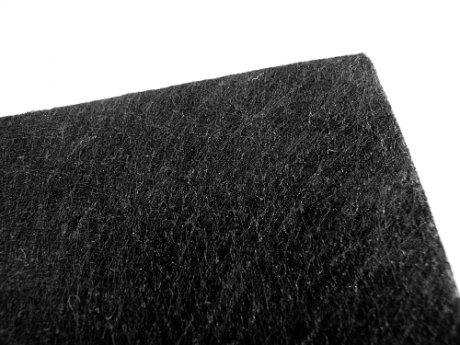
Non-woven geotextiles are produced by bonding or interlocking synthetic fibers, typically through a needle-punching process. This creates a porous, felt-like fabric with a three-dimensional structure. Unlike the grid pattern of woven fabrics, this random fiber orientation results in high permeability, allowing water to flow through effectively.
Their primary functions are filtration, drainage, and separation. In a French drain or behind a retaining wall, the non-woven fabric allows groundwater to pass into the drainage pipe or weep holes while preventing fine soil particles from migrating and clogging the system. This ensures long-term drainage performance. Its cushioning nature also makes it ideal for protecting geomembrane liners in landfills from punctures.
They are used mainly for separation, protection, and filtration purposes in the areas of roadway, railroad, landfill, or civil and environmental projects.
The manufacturing method uses a process with endless filaments to ensure the use of high-quality materials. Non-woven geotextiles are resistant to all chemicals and biological media occurring in the soil and construction materials.
The material cannot be dissolved by water, making it safe for groundwater. They are also equipped with U-stabilizer to provide extended resistance to direct sunlight.

The knitted geotextiles are made by interlocking a series of loops of yarn together. All the knitted geosynthetics are made using a knitted technique in conjunction with some other method of geosynthetics manufacturer, like weaving.
Apart from the geotextiles explained above, other geosynthetics include geonets, geogrids, geo-cells, geomembranes, geocomposites, etc. Each of them has its features, uses, and applications.
When selecting a non-woven geotextile, one of the most common specifications you will encounter is its weight, typically measured in ounces per square yard (oz/yd²). This measurement indicates the mass of the fabric and is a direct indicator of its thickness, durability, and robustness.
Different geotextile materials are used for various purposes, like separation, filtration, drainage, reinforcement, sealing, and protection.
For separation, a geotextile can be installed between two different soil materials.
The geotextile will help to separate dissimilar materials so that the required soil characteristics can be obtained.
The primary goal of filtration is to allow water to pass through a material while preventing soil particles from being carried with it. Non-woven geotextiles are ideal for this function due to their pore structure.
A classic example is wrapping a perforated drainage pipe with non-woven fabric. The geotextile allows groundwater to seep into the pipe, relieving hydrostatic pressure. At the same time, it holds back the surrounding sand, silt, and clay, which would otherwise enter the pipe and clog the entire system. This filtration function is critical for the long-term effectiveness of any subsurface drainage project.
Geotextiles, especially woven types, strengthen soil by adding tensile support, as soil is strong in compression but weak in tension. When placed within soil layers, they help create steeper slopes and more stable foundations.
For example, in road construction over soft ground, woven geotextiles are added within the base layer to improve load distribution and reduce movement. This forms a stronger composite material, preventing failure and enhancing long-term stability.
A geotextile fabric can be filled with asphalt or other mixes to make it impermeable, thereby making it capable of stopping the flow of water in both directions.
Geotextiles can be used to prevent contamination of soil or groundwater from pollutants above.
For protection, geotextiles can be used to absorb stress and thus reduce or prevent damage and erosion in geotechnical structures.
Embedding geotextiles in construction can help prevent significant damage, like soil erosion and wind damage.
By understanding these functions, you can select the right geotextile and ensure it is installed correctly to guarantee the long-term success and durability of your project.
Seek only experts with the right experience for geotextile installation in your site. For more information, contact our professional consultants.
Geotextiles are used across a wide range of infrastructure projects due to their versatility.
Geotextiles significantly extend pavement lifespan by maintaining structural integrity.
Proper installation is critical to unlocking the full benefits of geotextile fabric. While specific project requirements may vary, following these fundamental steps will ensure a successful application for projects like driveways, paths, and foundational support. Following a clear process prevents common mistakes and guarantees long-term performance.
Begin by clearing the designated area of all vegetation, large rocks, tree stumps, and sharp objects. Excavate the soil to the required depth for your project’s base layer. Ensure the subgrade surface is smooth, level, and compacted. Fill any soft spots or voids with granular material to create a stable, uniform foundation.
Place the geotextile fabric in the prepared area, rolling it out as smoothly as possible. The fabric should be stretched tight and lie flat without wrinkles. For adjacent rolls, overlap the edges by a minimum of 12 to 24 inches (30-60 cm). On sloped areas, always place the uphill fabric roll over the downhill roll (like roof shingles) to ensure water flows over the top of the seam, not into it.
To prevent the fabric from moving, secure it to the ground using 6-inch landscape staples or pins. Place staples along all seams and around the perimeter of the installation area. A spacing of approximately every 3 feet is generally sufficient to hold the fabric firmly in place while you place the top layer.
Once the fabric is secure, you can place the aggregate (such as gravel or crushed rock) on top. For driveway applications, a minimum depth of 8 to 12 inches is recommended, though this may vary based on soil stability and project plans. Place the material carefully to avoid damaging or displacing the fabric. Important: Do not drive heavy equipment directly on the exposed geotextile. Build up the aggregate layer by back-dumping from previously placed material.
Geotextiles are no longer optional—they are essential for resilient infrastructure.
Without proper soil management and drainage:
Geotextiles address these issues by:
Their ability to perform multiple functions simultaneously makes them a high-value engineering solution.
Driving progress in Geosynthetics Malaysia, GSSB is committed to building a sustainable future through eco-efficient engineering solutions. Our dedication to quality and performance ensures long-lasting results for infrastructure and environmental projects nationwide.
Discover how our expertise makes a difference.
Geotextiles have transformed modern construction by offering a reliable, versatile, and cost-effective solution to complex geotechnical challenges.
From improving soil stability to controlling drainage and preventing erosion, their applications are vast and critical to infrastructure success.
As construction standards continue to evolve, geotextiles will remain a cornerstone of sustainable and high-performance engineering design.
Woven geotextile is made by interlacing yarns in a grid pattern, giving it high tensile strength and low permeability — best for reinforcement and stabilization. Non-woven geotextile is made by bonding fibers together into a felt-like fabric, giving it high permeability and filtration ability, but lower tensile strength.
For most driveway underlayment, a mid-weight non-woven or woven geotextile (6-8 oz/yd²) offers the right balance of permeability and strength. Heavyweight (10-16 oz) is better reserved for rip-rap underlayment or roadway separation under heavy traffic loads.
Adjacent rolls should overlap by at least 12 to 24 inches (30-60 cm). On slopes, place the uphill roll over the downhill roll, similar to roof shingles, so water flows over the seam instead of into it.
No. Heavy equipment should never be driven directly on exposed geotextile fabric — this can tear or displace it. Aggregate should be back-dumped from previously placed material to build up the base layer without direct contact.
Copyright © Gateway Structure Sdn Bhd (199401025111). All Right Reserved.