
Key Takeaways
Using geotextiles in pavement construction increases durability and reduces maintenance costs, making them a practical solution for challenging ground conditions.
Why do roads built on soft soil often deteriorate faster than expected?
In many cases, the issue lies beneath the surface—where weak subgrade conditions fail to support repeated traffic loads. Soft soils, such as clay or silt, lack the strength and stability required for long-lasting pavement performance.
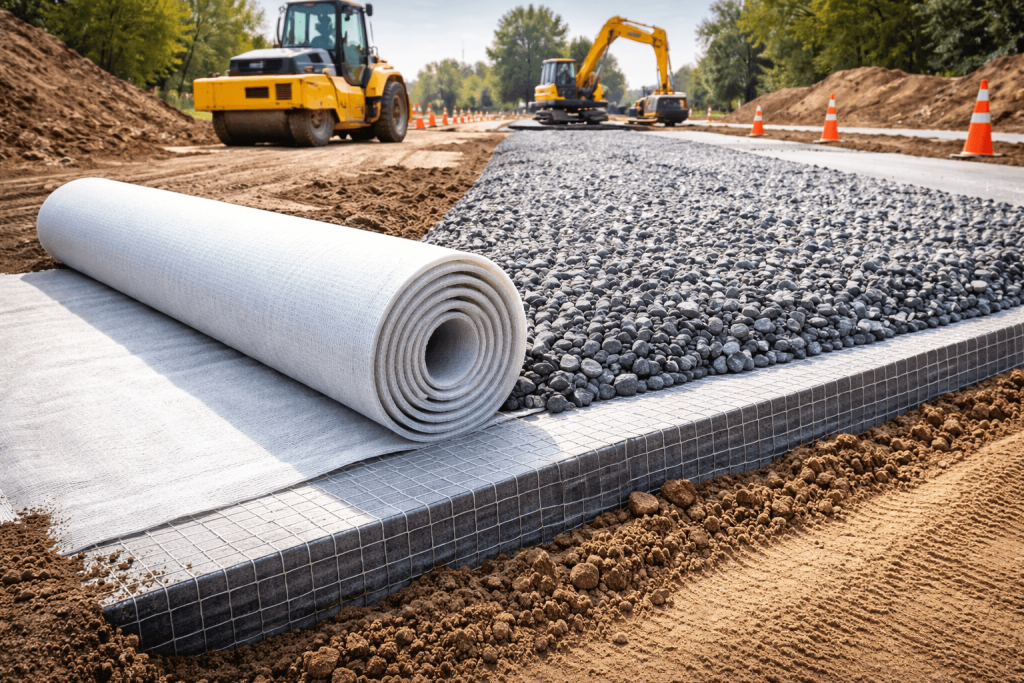
This is where geotextiles play a critical role. Widely used in modern pavement construction, geotextiles are engineered fabrics designed to improve soil behaviour and structural performance. By reinforcing weak ground, separating layers, and enhancing drainage, geotextiles help extend the lifespan of roads built on challenging soil conditions.
Understanding how geotextiles function and their impact on pavement performance is essential for engineers, contractors, and project owners working in infrastructure development.
Geotextiles are permeable synthetic fabrics, typically made from polypropylene or polyester, used in civil engineering and construction applications. They are designed to interact with soil to improve its mechanical and hydraulic properties.
There are two main types used in pavement construction:
Each type is selected based on project requirements and soil conditions.
Soft soils present several engineering challenges:
Soft soil cannot adequately support loads, leading to deformation under traffic.
Long-term settlement can cause uneven pavement surfaces.
Water retention weakens soil strength and accelerates pavement deterioration.
Repeated loading causes fine particles to move upward, destabilising the pavement structure.
Without proper intervention, these issues can significantly reduce pavement lifespan and increase maintenance costs.
Geotextiles enhance pavement systems through several key functions:
Function
Geotextiles act as a barrier between the subgrade (soft soil) and the aggregate base layer.
Benefits
Without separation, aggregate can sink into soft soil, reducing pavement thickness and strength.
Function
Geotextiles provide tensile strength to support loads that the soil alone cannot handle.
Benefits
This reinforcement effect is particularly important in roads with heavy or repeated traffic loads.
Function
Geotextiles allow water to pass through while retaining soil particles.
Benefits
Function
Geotextiles facilitate water movement within the pavement structure.
Benefits
Proper drainage is essential for maintaining soil strength over time.
Function
Geotextiles stabilise soil surfaces and protect against erosion caused by water flow.
Benefits
When installed within a pavement structure, geotextiles interact with both soil and aggregate layers.
This combined effect results in a more stable and durable pavement system.
Geotextiles are widely used in:
They are particularly valuable in areas with high moisture content or weak soil conditions.
Geotextiles help maintain structural integrity, reducing early failure.
Less frequent repairs and rehabilitation are required.
Lower aggregate thickness may be needed due to improved load distribution.
Simplifies ground preparation and stabilisation processes.
Minimises material usage and reduces environmental impact.
To achieve optimal performance, several factors must be considered:
Selecting the right geotextile and ensuring correct installation are critical to achieving desired outcomes.
Using the wrong type of geotextile can compromise performance.
Wrinkles, folds, or damage during installation reduce effectiveness.
Insufficient overlap can lead to layer separation failure.
Without proper drainage, water can still weaken the subgrade.
Sustainable construction is driving the increased use of recyclable and eco-friendly geotextile materials, helping reduce environmental impact while maintaining performance.
At the same time, advancements in material technology have led to the development of geotextiles with enhanced strength and durability, making them more suitable for demanding applications.
Additionally, the rise of smart infrastructure is enabling the integration of monitoring systems, allowing engineers to track performance and condition in real time for improved maintenance and long-term reliability.
Geotextiles play a vital role in improving pavement performance on soft soil by enhancing stability, reinforcing weak ground, and ensuring proper drainage. Their ability to address multiple engineering challenges makes them an essential component in modern pavement construction.
By preventing common issues such as rutting, settlement, and erosion, geotextiles contribute to longer-lasting and more reliable infrastructure.
For projects involving soft soil conditions, incorporating geotextiles into pavement design can significantly improve performance and cost efficiency.
Consulting with experienced geotechnical specialists or suppliers can help ensure the right solution is applied for your specific project needs, leading to more resilient and sustainable pavement systems.
Copyright © Gateway Structure Sdn Bhd (199401025111). All Right Reserved.