
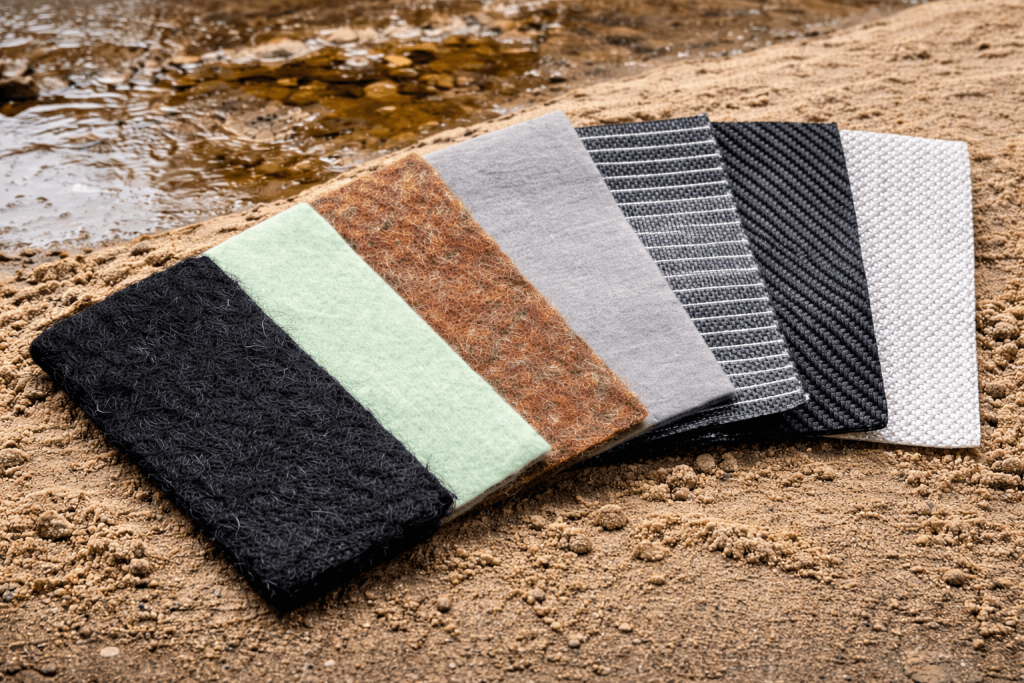
What makes modern civil engineering projects stronger, more durable, and cost-efficient despite challenging ground conditions?
In today’s infrastructure development, choosing the right construction materials is essential for long-term performance. Among these, geotextile fabric has become a vital solution in applications such as road construction, drainage, erosion control, and soil stabilisation.
This article introduces the main types of geotextile fabric, explains how they work, and outlines their practical uses in civil engineering—helping professionals understand how woven and non woven geotextile fabric contribute to safer, more reliable structures.
Geotextile fabric is a permeable synthetic textile made from polymers such as polypropylene or polyester. It is designed to interact with soil, rock, and water to improve the mechanical and hydraulic behaviour of civil engineering systems.
Unlike traditional construction materials such as concrete or steel, geotextiles are flexible, lightweight, and easy to install. They perform several key functions simultaneously, including:
Because of these multi-functional capabilities, geotextile fabric is widely used across infrastructure, environmental, and geotechnical projects.
Geotextile fabrics are generally classified based on their manufacturing process and physical structure. Each type is suited to specific engineering requirements.
Characteristics
Woven geotextile fabric is produced by weaving individual synthetic fibres or yarns together in a regular pattern, similar to traditional textiles. This manufacturing method creates a fabric with high tensile strength and low elongation.
Key characteristics include:
Woven geotextile fabric is commonly used in applications where strength and reinforcement are the primary requirements, such as:
In these applications, the fabric distributes loads more evenly across weak subgrades, reducing rutting and settlement. As a result, it improves pavement performance and extends service life.
Characteristics
Non woven geotextile fabric is manufactured by bonding fibres together through mechanical, thermal, or chemical processes rather than weaving. This creates a fabric with a random fibre structure, resulting in higher permeability and flexibility.
Key characteristics include:
Non woven geotextile fabric is widely used where filtration, drainage, and separation are required, including:
Because of its superior water permeability, non woven geotextile fabric is ideal for managing groundwater and surface runoff while preventing soil migration that can compromise structural integrity.
Characteristics
Knitted geotextiles are produced by interlocking loops of yarns, sometimes combined with weaving techniques. While less common than woven or non-woven types, knitted geotextiles offer unique performance characteristics.
Key characteristics include:
Knitted geotextile fabrics are typically used in niche applications where flexibility is more important than strength, such as:
Their ability to stretch and adapt makes them suitable for areas experiencing differential settlement or movement.
Understanding how geotextile fabric functions helps explain why it is such a valuable construction material.
One of the primary roles of geotextile fabric is separating different soil layers to prevent intermixing. For example, in road construction, geotextiles prevent fine subgrade soil from migrating into coarse aggregate layers, preserving structural integrity.
Geotextile fabrics allow water to pass through while retaining soil particles. This filtration function is essential in drainage systems, embankments, and erosion control structures, where maintaining soil stability is critical.
Non woven geotextile fabric, in particular, facilitates efficient water drainage by providing continuous flow paths. This reduces hydrostatic pressure behind retaining walls and beneath pavements.
Woven geotextile fabric provides tensile reinforcement, increasing soil bearing capacity and reducing deformation under load. This is especially beneficial in weak or soft soil conditions.
Geotextile fabric is often used as a protective layer over geomembranes and waterproofing systems, preventing puncture or abrasion from overlying materials.
Geotextile fabric improves pavement performance by stabilising subgrades, reducing material thickness, and enhancing load distribution. This leads to lower construction costs and reduced maintenance over time.
Non woven geotextile fabric is extensively used in drainage applications to maintain water flow while preventing clogging. It plays a critical role in stormwater systems, retaining walls, and underground drainage networks.
Geotextile fabric stabilises soil surfaces and prevents erosion caused by water flow. When combined with vegetation or riprap, it helps protect slopes, riverbanks, and embankments.
In environmental applications, geotextile fabric is used in landfill liners, leachate collection systems, and containment structures. It enhances filtration, drainage, and protection while supporting environmental compliance.
Geotextiles are used in shoreline protection, breakwaters, and hydraulic structures to manage water flow and reduce soil loss. Their flexibility allows them to adapt to dynamic marine environments.
Geotextile fabric offers several advantages over traditional construction materials:
These benefits make geotextiles an increasingly popular choice in both small-scale and large-scale civil engineering projects.
Selecting the appropriate geotextile fabric depends on several factors, including:
Proper material selection, combined with correct installation practices, ensures that the geotextile performs its intended function throughout the project’s lifecycle.
As infrastructure demands increase and sustainability becomes a greater priority, geotextile fabric will continue to evolve. Advances in polymer technology, manufacturing techniques, and performance testing are driving the development of more durable, efficient, and environmentally responsible geosynthetic solutions.
Geotextiles are no longer considered supplementary materials—they are now fundamental components of modern civil engineering design.
Understanding the different types of geotextile fabric and their applications is essential for engineers, contractors, and project owners seeking reliable and cost-effective construction materials. Whether using woven geotextiles for reinforcement or non woven geotextile fabric for drainage and filtration, these materials provide proven solutions to complex ground engineering challenges.
By integrating geotextile fabrics into civil engineering projects, professionals can achieve stronger, more resilient, and more sustainable infrastructure outcomes.
Copyright © Gateway Structure Sdn Bhd (199401025111). All Right Reserved.