
Key Takeaways
Have you ever wondered how buildings, roads, or ports are constructed on weak or soft ground?
Ground improvement is a geotechnical engineering process used to modify soil properties so it can safely support structures. Instead of removing unsuitable soil, engineers improve it in place to meet design requirements.
This approach is widely used because it:
In countries like Malaysia, where soft clay and reclaimed land are common, ground improvement is essential for safe and sustainable development.
Ground improvement is typically used when:
In such cases, ground improvement provides a practical alternative to excavation or piling, improving soil performance without major structural changes.
Ground improvement techniques can be broadly categorised based on how they modify soil behaviour.
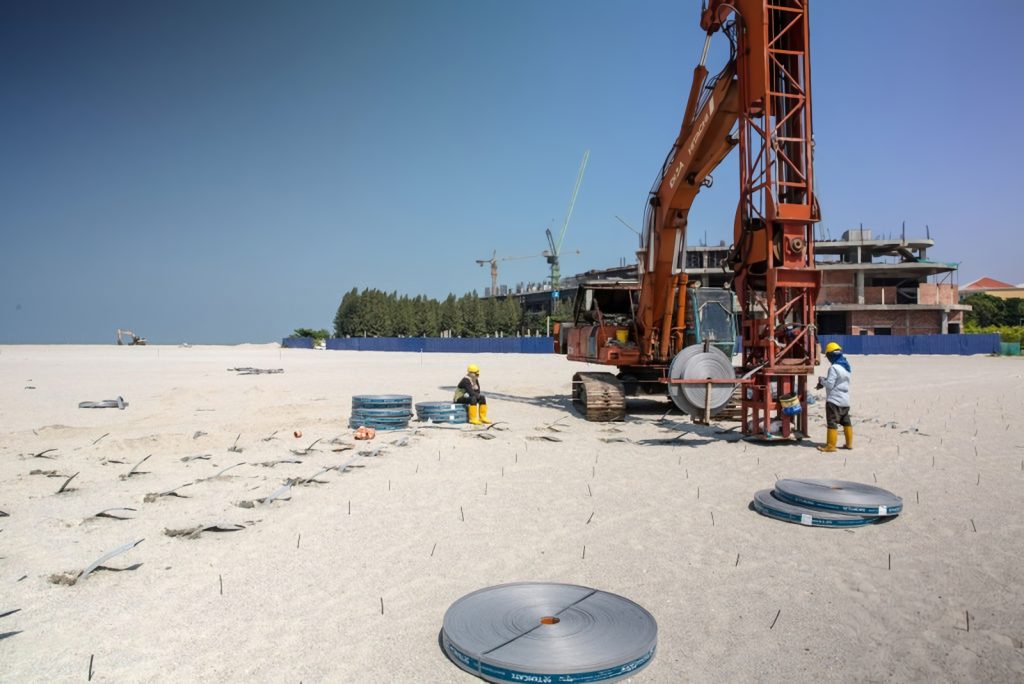
Prefabricated vertical drains are prefabricated geotextile filter-wrapped plastic strips with molded channels.
Also known as band drains or Wick Drains, prefabricated vertical drains serve as drainage paths to take pore water out of soft compressible soils that consolidate faster under a constant surcharge load.
Benefits
Common Uses
Dynamic compaction is a ground improvement technique that involves the controlled impact of a crane hoisted weight, (usually around 10-30 tonnes), falling in a pre-determined grid pattern. DC aims to improve loose, granular soils and fills.
Benefits
Common uses
👉 A cost-effective method for large-scale ground improvement projects.
Vibro compaction is an old ground improvement method that uses a downhole vibrator to densify clean, cohesionless granular soils.
Benefits
Common uses
👉 Particularly effective for improving loose sand deposits.
Deep soil mixing involves two methods: wet and dry method.
The deep soil mixing wet method improves the characteristics of weak soils by mechanically mixing them with cementitious binder slurry.
Benefits
Common uses
The deep soil mixing dry method improves peats, soft, high moisture clays, and other weak soils, by mechanically mixing them with the dry cementitious binder.
Benefits
Common uses
This method produces soil with higher strength and lower compressibility, making it suitable for heavy structures.
Rigid inclusion is a ground improvement technique that uses high-deformation modulus columns constructed through compressible soils to increase bearing capacity and reduce settlement.
Benefits
Common uses
👉 Commonly used for warehouses, highways, and heavy foundations.
| Method | Best Soil Type | Main Function | Key Advantage |
|---|---|---|---|
| PVD | Soft clay | Drainage | Fast consolidation |
| Dynamic Compaction | Loose fill | Densification | Cost-effective |
| Vibro Compaction | Sand | Densification | Improves stiffness |
| Deep Soil Mixing | Clay | Stabilisation | High strength |
| Rigid Inclusions | Weak soils | Load transfer | Settlement control |
With increasing land scarcity, many developments are built on challenging soil conditions.
Ground improvement enables:
It has become a standard engineering solution for infrastructure, ports, highways, and industrial developments.
Ground improvement is not just about fixing weak soil—it’s about unlocking the potential of land for safe and sustainable development.
The most effective projects combine multiple techniques to achieve:
Stronger, more stable, and long-lasting foundations
As part of the growing field of Geosynthetics Malaysia, GSSB continues to lead through innovation, engineering excellence, and a deep understanding of local infrastructure needs. Our team is driven by the vision to deliver quality solutions that last.
Learn more about who we are and what drives us.
Copyright © Gateway Structure Sdn Bhd (199401025111). All Right Reserved.