
Key Takeaways
Have you ever wondered why some roads, retaining walls, or drainage systems last for decades while others fail within a few years? In many cases, the answer lies beneath the surface—literally. A hidden but critical component called geotextile fabric often plays a major role in stabilising soil, improving drainage, and preventing erosion.
Geotextile installation has become a standard practice in modern construction, landscaping, road engineering, and environmental projects.
However, while the material itself is highly effective, its performance depends heavily on how it is installed. Improper installation can reduce efficiency, cause structural issues, or even lead to costly project failures.
For beginners entering the field of geosynthetics or civil construction, understanding the fundamentals of installing geotextile fabric is essential. This guide explains the entire process step-by-step, common mistakes to avoid, and why working with a professional geosynthetic installer can make a significant difference in project outcomes.
Geotextile fabric is a permeable synthetic textile used in civil engineering and construction projects to interact with soil and improve its performance. It is commonly manufactured from materials such as polypropylene or polyester and is designed to perform several critical functions underground.
These functions include:
Separation – preventing different soil layers from mixing
Filtration – allowing water to pass while retaining soil particles
Drainage – directing water flow through the structure
Reinforcement – increasing soil strength and load capacity
Protection – protecting membranes or structures from damage
Geotextiles are widely used in projects such as:
Road construction
Railway tracks
Drainage systems
Coastal protection
Landscaping and retaining walls
When properly installed, geotextiles can significantly improve soil stability and reduce erosion while extending the lifespan of infrastructure projects.
Before installing geotextile fabric, it is important to choose the correct type for the project. Different geotextiles are designed for different engineering functions.
Woven geotextiles are produced by weaving polypropylene tapes together. They are known for:
High tensile strength
Strong load-bearing capacity
Effective soil reinforcement
Typical applications include road bases, embankments, and areas where heavy loads are expected.
Non-woven geotextiles are manufactured through needle punching or heat bonding fibres together.
Key characteristics include:
High permeability
Excellent filtration capability
Good drainage performance
These fabrics are often used in drainage systems, landscaping, and erosion control.
Knitted geotextiles combine characteristics of woven and non-woven fabrics and are used in specialised engineering applications.
Selecting the correct type is critical because each material interacts with soil differently and performs specific engineering functions.
Even high-quality geotextile materials cannot deliver expected results without correct installation. The installation process ensures that the fabric maintains proper contact with the soil and performs its intended functions.
Correct installation helps achieve:
Improved soil stabilisation
Reduced erosion and sediment movement
Better drainage performance
Extended lifespan of roads or structures
Lower maintenance costs
On the other hand, poor installation can lead to wrinkles, tears, insufficient overlaps, or fabric displacement, which can significantly reduce the effectiveness of the geotextile layer.
The following process outlines the standard procedure for installing geotextile fabric in construction and landscaping projects.
Before installation begins, engineers or contractors must evaluate the project site.
Important factors to assess include:
Soil conditions
Drainage patterns
Slope and terrain
Load requirements
Environmental factors
This evaluation helps determine the appropriate geotextile type and installation method.
Proper ground preparation is one of the most important stages of geotextile installation.
The site should be prepared by:
Removing vegetation, rocks, roots, and debris
Levelling the ground surface
Filling weak or unstable soil areas
Compacting the soil if necessary
A smooth and stable surface reduces the risk of puncturing or damaging the geotextile fabric during installation.
After preparing the ground, the installation area must be measured accurately.
The geotextile roll is then cut to the required dimensions. During this stage, installers should:
Allow extra material for overlaps
Avoid uneven edges
Ensure accurate measurements
Typically, an overlap of 300–450 mm (12–18 inches) is recommended between adjacent fabric sections to prevent gaps.
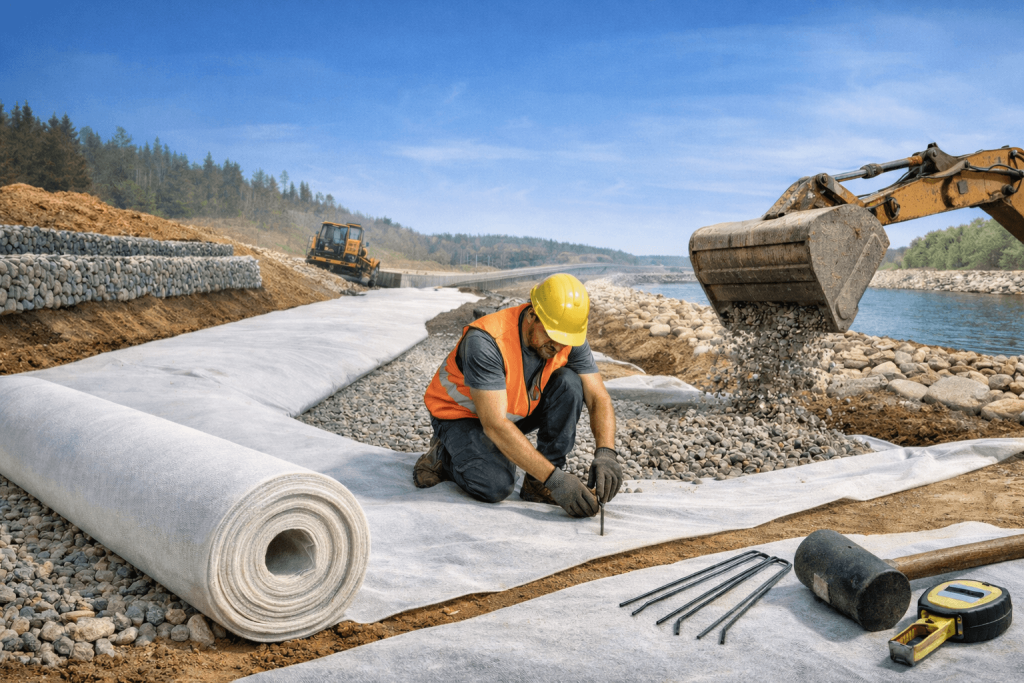
Next, the geotextile fabric is rolled out across the prepared surface.
Important installation practices include:
Laying the fabric flat without wrinkles
Avoiding tension or stretching
Aligning the fabric according to slope or water flow direction
Using temporary weights such as sandbags if necessary
Smooth installation ensures full contact between the geotextile and the soil, allowing it to perform its filtration and separation functions effectively.
To prevent movement during construction, the geotextile must be secured properly.
Common anchoring methods include:
Landscape staples
Steel pins
Anchor trenches
Temporary weights
Anchors are typically placed every 1 to 1.5 metres along overlaps or edges.
Proper anchoring prevents displacement caused by wind, machinery, or soil movement.
Large projects require multiple rolls of geotextile fabric.
These sections are connected using either:
Overlapping
Sewing or stitching
Overlapping is often sufficient for low-load applications, while stitching is preferred for high-stress environments such as road construction.
Ensuring strong seams helps maintain structural integrity across the entire installation.
Once the fabric is securely installed, the next step is placing soil or aggregate over it.
Backfill materials may include:
Gravel
Crushed stone
Sand
Soil layers
The material should be placed gradually and evenly to avoid puncturing or shifting the geotextile layer.
Heavy machinery should never drive directly on exposed geotextile fabric. Instead, a protective layer should be placed first.
Before completing the project, installers must inspect the entire installation.
Quality checks typically include:
Checking overlaps and seams
Inspecting for tears or damage
Confirming proper alignment
Ensuring the fabric remains flat and secure
Regular inspections help detect potential problems early and ensure long-term performance.
Beginners often encounter issues during geotextile installation due to lack of experience.
Common mistakes include:
Sharp objects or uneven surfaces can puncture the fabric.
Small gaps between fabric sections allow soil migration.
Wrinkles reduce soil contact and weaken performance.
Loose fabric can shift during backfilling.
Exposing geotextiles to sunlight for extended periods may weaken the material.
Avoiding these mistakes is essential for achieving long-term project durability.
Although installing geotextile fabric may appear straightforward, professional expertise is often necessary for large or technical projects.
A geosynthetic installer specialises in the installation of geotextiles, geomembranes, and other geosynthetic materials used in civil engineering.
Hiring a professional installer offers several advantages.
Experienced installers understand:
Soil mechanics
Load distribution
Material specifications
Environmental conditions
This knowledge helps ensure the correct geotextile type and installation method are used.
Professional installers follow industry standards such as ASTM or ISO guidelines.
They perform inspections and testing to ensure:
Proper seam strength
Correct overlaps
Accurate placement
This reduces the risk of project failure.
Specialised equipment and trained crews allow professional installers to complete projects faster and more efficiently.
This can significantly reduce labour costs and construction delays.
Improper installation can lead to drainage problems, soil erosion, or structural damage.
Professional installation helps minimise these risks and ensures the geotextile system performs as designed.
Geotextile systems are designed to last for decades when installed correctly.
Professional installers help maximise durability, reducing maintenance costs over the life of the project.
Geotextile fabric is widely used across many industries.
Common applications include:
Separates soil layers and stabilises road bases.
Improves water flow while filtering soil particles.
Prevents soil pressure buildup and erosion.
Reduces erosion along shorelines.
Controls weeds and improves drainage beneath decorative surfaces.
Because of its versatility, geotextile installation has become a core technique in modern infrastructure development.
Geotextile fabric plays a crucial role in improving soil stability, managing drainage, and extending the lifespan of infrastructure projects. However, the success of any geotextile system depends heavily on correct installation procedures.
From preparing the ground and laying the fabric to securing overlaps and applying backfill, every step must be carefully executed to ensure optimal performance.
For beginners, understanding the fundamentals of geotextile installation is an important first step. But for complex or large-scale projects, working with a professional geosynthetic installer can provide the expertise, quality control, and efficiency required for long-term success.
If you are planning a construction, landscaping, or infrastructure project that involves geotextiles, consider consulting experienced geosynthetic specialists. The right installation approach today can save significant costs and maintenance efforts in the future.
Copyright © Gateway Structure Sdn Bhd (199401025111). All Right Reserved.